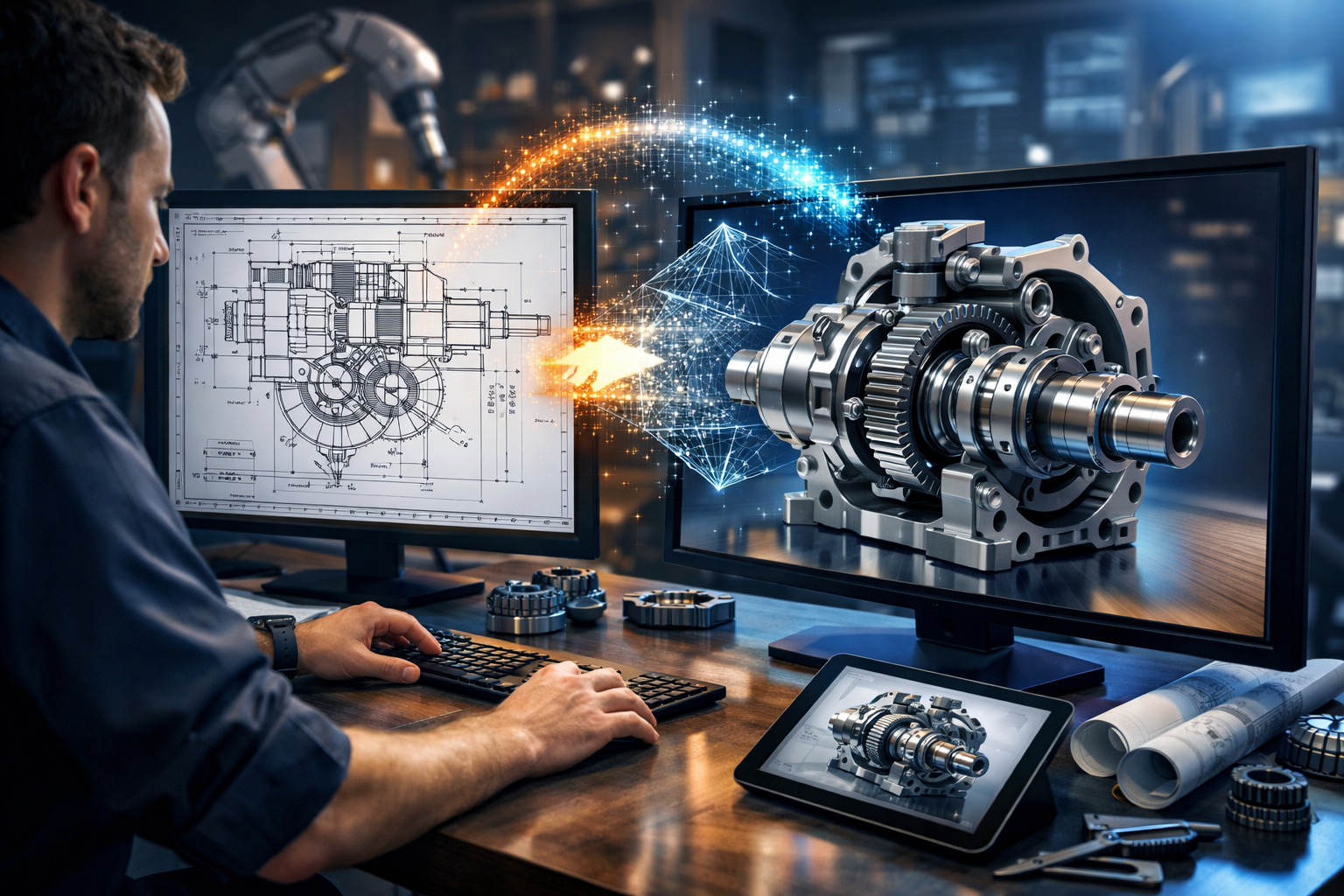

The design and construction industries are undergoing one of the biggest digital transformations in history. Across the UK and the USA, businesses are rapidly upgrading from flat technical drawings to intelligent 3D models. At the center of this shift is a growing reliance on 2D to 3D cad conversion services.
What was once considered an optional upgrade has now become a strategic necessity.
From architecture firms in London to manufacturing companies seeking cad conversion services in USA, organizations are recognizing that legacy 2D drawings simply cannot support modern BIM workflows, digital twins, or AI-driven design tools.
In 2026, the demand for 2D CAD Conversion Services is not just rising, it’s accelerating.
Let’s explore why.
What Are 2D to 3D CAD Conversion Services and Why Are They So Important Today?
2D to 3D cad conversion services involve transforming traditional 2D plans, elevations, and technical drawings into fully detailed 3D digital models.
These models allow teams to:
- Visualize designs from every angle
- Detect clashes before construction
- Improve material estimation accuracy
- Integrate with BIM platforms
- Run structural simulations
- Present immersive client walkthroughs
An Accurate CAD Conversion Service doesn’t just redraw files it rebuilds them intelligently, preserving design intent while making them digitally ready for modern tools.
In 2026, that digital readiness determines competitiveness.
Why Are UK and USA Markets Driving the Growth of 2D CAD Conversion Services?
1. Is BIM Adoption Fueling Demand?
Yes significantly.
The UK has long been a leader in BIM implementation. The Centre for Digital Built Britain has played a major role in advancing national BIM standards. Public sector projects require structured digital data, and 3D-ready models are essential for compliance.
In the US, the National Institute of Building Sciences continues promoting digital building standards, increasing BIM integration across federal and private projects.
But here’s the challenge:
Thousands of existing buildings and industrial facilities still rely on 2D drawings.
To enter BIM ecosystems, these drawings must first undergo professional 2D CAD Conversion Services.
That requirement alone is driving massive demand.
2. Are Legacy 2D Drawings Slowing Down Projects?
Absolutely.
Across both markets, firms are sitting on decades of 2D CAD archives. These drawings:
- Lack data intelligence
- Cannot support simulation
- Increase misinterpretation risks
- Limit cross-team collaboration
Renovation-heavy cities like London, Manchester, New York, and Boston are seeing a surge in conversion requests. Converting legacy blueprints into 3D models helps architects detect structural conflicts before they become costly site errors.
That’s why businesses increasingly search for reliable cad conversion services in USA and UK-based specialists.
How Does an Accurate CAD Conversion Service Improve Project Profitability?
Construction rework remains one of the industry’s most expensive problems.
According to research referenced by the American Institute of Architects, improved visualization significantly reduces late-stage design modifications.
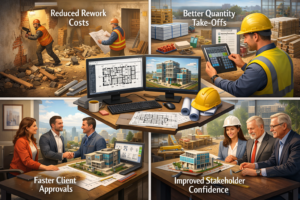
Here’s how Accurate CAD Conversion Service providers directly impact ROI:
1. Reduced Rework Costs
Clash detection in 3D minimizes onsite corrections.
2. Better Quantity Take-Offs
Material estimates become more precise.
3. Faster Client Approvals
3D models communicate intent clearly.
4. Improved Stakeholder Confidence
Investors prefer visual data over technical line drawings.
In practical terms, digital accuracy equals financial control.
How Is Technology Accelerating the Need for 2D to 3D CAD Conversion Services?
Cloud Collaboration
Modern projects rely on cloud-based BIM systems. These platforms require 3D models not flat CAD files.
Without conversion, teams cannot collaborate effectively across geographies.
AI-Driven Design Tools
AI and generative design systems depend on structured 3D data. Converting 2D drawings today prepares companies for tomorrow’s automation workflows.
Sustainability & Carbon Tracking
3D models support:
- Energy simulations
- Lifecycle analysis
- Carbon footprint measurement
With ESG regulations tightening in both the UK and USA, 3D-enabled sustainability modeling is becoming mandatory for large-scale projects.
Which Industries Are Fueling Demand for 2D CAD Conversion Services?
Architecture & Urban Redevelopment
The Office for National Statistics reports steady growth in UK construction output over recent years. Urban retrofitting and infrastructure modernization projects require updated digital documentation.
Converting 2D layouts into BIM-compatible 3D models is now a routine requirement.
Manufacturing & Product Engineering
Manufacturers seeking cad conversion services in USA often need to transform 2D mechanical drawings into 3D models for:
- CNC machining
- 3D printing
- Reverse engineering
- Prototyping
Without 3D geometry, simulation and production optimization are impossible.
Real Estate & Property Development
Planning authorities increasingly prefer 3D visual submissions. Developers rely on 2D to 3D cad conversion services to create:
- Investor-ready renderings
- Planning approval documentation
- Marketing walkthroughs
Static PDFs no longer meet stakeholder expectations.
Why Is Outsourcing 2D to 3D CAD Conversion Services Becoming Popular?
In 2026, many mid-sized architecture and engineering firms are outsourcing 2D CAD Conversion Services rather than hiring large in-house modeling teams.
Key reasons include:
- Cost efficiency
- Faster turnaround
- Access to experienced CAD professionals
- Scalable project capacity
This trend is especially strong among startups and tech-driven AEC firms in both the UK and USA.
What Challenges Should Businesses Consider Before Converting 2D to 3D?
Even though demand is rising, successful conversion requires expertise.
Common challenges include:
- Missing dimensions in legacy files
- Outdated compliance standards
- Non-standard layering systems
- Poor drawing quality
An inexperienced provider can misinterpret design intent.
That’s why choosing a professional Accurate CAD Conversion Service with architectural and engineering knowledge is essential.
How Will 2D to 3D CAD Conversion Services Shape the Future Beyond 2026?
The next wave of digital transformation includes:
- Digital twins
- AR/VR-based design validation
- Generative AI design systems
- Automated compliance checks
All these innovations rely on structured 3D data.
Companies that invest in 2D to 3D cad conversion services today are laying the groundwork for:
- Smart city integration
- Predictive maintenance modeling
- Lifecycle asset management
Simply put, 3D models are becoming long-term digital assets, not just design tools.
Final Thoughts
The rapid rise of 2D to 3D cad conversion services in 2026 reflects a permanent shift in how architecture, engineering, manufacturing, and real estate projects are executed.
In both the UK and the USA, firms are modernizing legacy drawings to:
- Improve accuracy
- Reduce risk
- Enhance collaboration
- Accelerate approvals
- Increase profitability
As BIM mandates expand and AI-driven workflows become standard, demand for professional 2D CAD Conversion Services and trusted cad conversion services in USA will continue to grow.
For businesses seeking reliable results, partnering with an experienced UK-based CAD design company that understands global compliance standards can ensure smooth digital transformation without disruption.
In the digital-first economy of 2026, converting 2D drawings into intelligent 3D models isn’t just an upgrade, it’s a competitive advantage.
FAQs
Why are 2D to 3D CAD conversion services in high demand in 2026?
2D to 3D CAD conversion services are in high demand in 2026 because businesses in the UK and USA are adopting BIM workflows, digital twins, and AI-driven design tools. Legacy 2D drawings must be converted into intelligent 3D models to improve collaboration, reduce rework costs, and meet compliance standards.
What industries need 2D CAD Conversion Services the most?
Industries that rely heavily on 2D CAD Conversion Services include:
- Architecture and construction
- Manufacturing and product engineering
- Real estate development
- Infrastructure modernization
- Industrial plant design
These sectors require accurate 3D models for simulation, visualization, and regulatory approvals.
How do CAD conversion services in USA improve project accuracy?
Professional CAD conversion services in USA improve project accuracy by transforming flat 2D drawings into detailed 3D models that allow clash detection, material estimation, and design validation before construction begins. This significantly reduces costly onsite errors and project delays.
What is the difference between 2D CAD drawings and 3D CAD models?
2D CAD drawings are flat technical representations showing plans and elevations.
3D CAD models are intelligent digital structures that allow visualization from multiple angles, structural analysis, and BIM integration.
In 2026, 3D models are essential for digital construction workflows.
How does an Accurate CAD Conversion Service reduce construction costs?
An Accurate CAD Conversion Service reduces costs by:
- Detecting clashes early
- Improving quantity take-offs
- Enhancing client visualization
- Reducing rework
- Supporting faster approvals
Digital accuracy directly impacts profitability.
Are 2D to 3D CAD conversion services necessary for BIM projects?
Yes. BIM platforms require structured 3D data. Without converting 2D drawings into 3D models, integration into BIM systems is not possible. This makes 2D to 3D CAD conversion services essential for public and private sector projects in both the UK and USA.
How do I choose the right CAD conversion services provider in the UK or USA?
When selecting a CAD conversion services provider, look for:
- Industry experience
- BIM compatibility
- Data security standards
- Proven portfolio
- Quality assurance processes
Choosing an experienced provider ensures technical accuracy and compliance with regional building standards.